The closest airport to Kotor is Tivat, about 8 km away. The alternatives are Podgorica (about 79 km) and Dubrovnik in Croatia (about 71 km, across the border). From Dubrovnik there are direct buses, and by car you can take the Kamenari–Lepetane ferry or go around the bay. Montenegro is not in the EU or in Schengen, so you need a valid document at the border, and the roaming of EU phone plans does not work automatically. Distances and times are estimates without traffic, border waits or ferry waits.
Book a tour
From Dubrovnik: Perast, Kotor and Budva in a small group (9-11 hours)
via GetYourGuide
Airports
Tivat (TIV) is about 8 km from Kotor, around ten minutes by car. Podgorica (TGD) is about 79 km away, around 95 minutes by car. Dubrovnik (DBV) is about 71 km away, but you cross the border. For taxis in Kotor, these are the numbers: 19719, 19737, 19708 and 19757.
Bus from Dubrovnik
From Dubrovnik to Kotor there are four departures a day: at 7:15 (arrival 9:45), 11:00 (13:10), 15:00 (17:00) and 17:30 (19:50). The ticket costs about €31 to €38, with booking and terminal service included. The 17:30 run can only be bought at the ticket office. In the opposite direction, from Kotor to Dubrovnik, buses leave at 10:10, 14:40 and 18:00, and the last run can only be bought at the ticket office.
Online tickets are bought at least two hours before departure. At weekends and in other seasons the times may change.
Kotor’s station is on Put Prvoboraca, in Škaljari, about 0.75 km from the Sea Gate, around a 10-minute walk. Buses leave from there for about 50 destinations, including Budva, Cetinje, Tivat, Herceg Novi, Podgorica and Dubrovnik. For Perast and Risan there is the local K7 line, designed for schools: it does not run at weekends, on public holidays, from 10 June to 31 August and from 1 to 20 January, so do not plan your visit around it.
By car from Dubrovnik
To reach Kotor by car you have two roads. Both go through the Karasovići (Croatia) and Debeli Brijeg (Montenegro) border crossing and then through Herceg Novi.
- With the Kamenari–Lepetane ferry: 79.4 km, about 1 hour 50 minutes.
- Around the bay, through Verige, Risan and Perast, without the ferry: 94.3 km, about 2 hours 25 minutes.
The time with the ferry counts the crossing as 5 minutes; in summer it actually takes about 15, plus the wait at the ramp. Neither route includes border waits. From the Kamenari ramp to Kotor, the road around the bay is 29.5 km, about 48 minutes. With the ferry it is 15.1 km, about 19 minutes, after the crossing and any wait. For Kotor the ferry saves little time; it is worth more if you are going to Tivat, the airport or Budva.
Speed limits are 50 km/h in built-up areas, 80 km/h on other roads, 100 km/h on motor-vehicle roads and 130 km/h on motorways. During the day you need dipped headlights or daytime running lights, and from 15 November to 30 March winter equipment.
The Old Town is pedestrian. Among the public car parks, Riva is the closest and also the most expensive, Benovo, near the port, costs less, and Autoboka is about 0.9 km on foot from the Sea Gate.
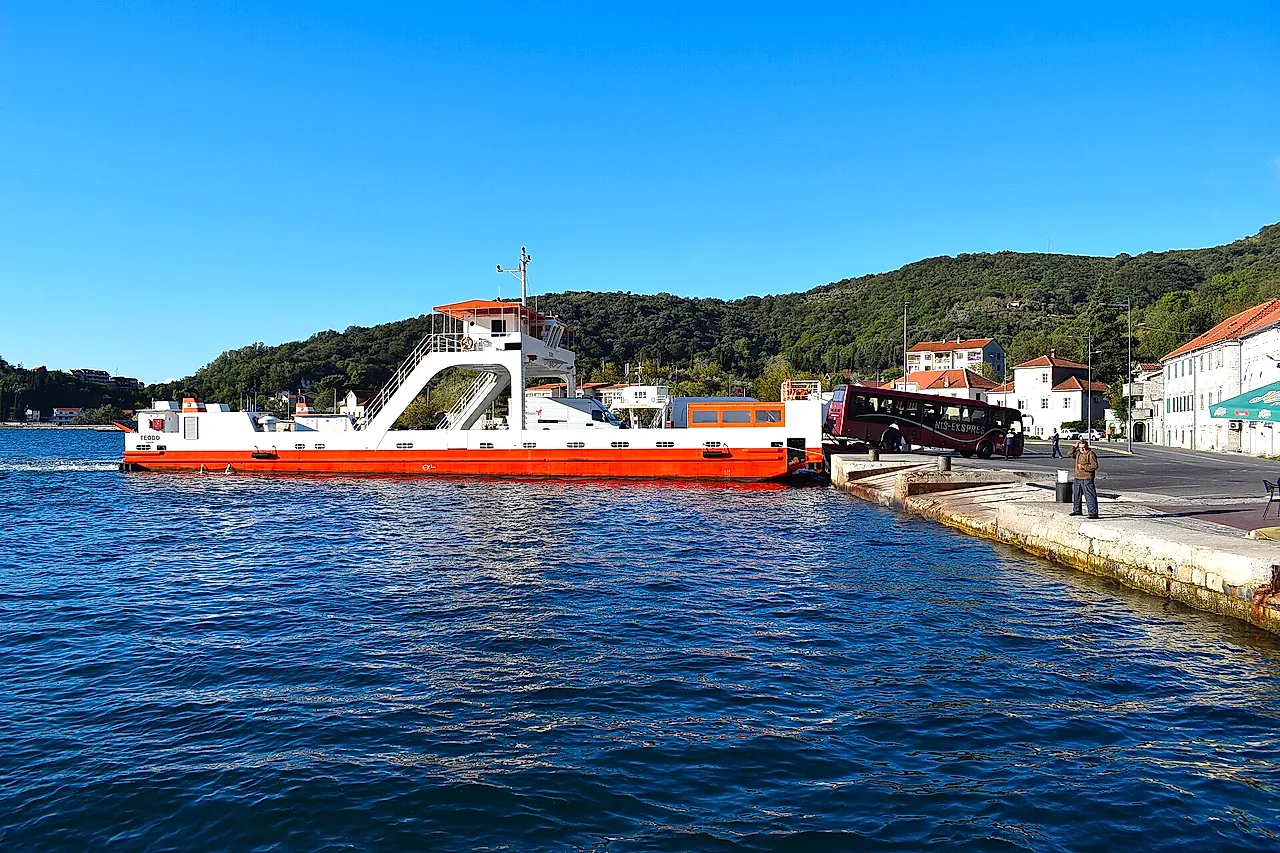
The Kamenari–Lepetane ferry
The ferry crosses the Verige strait and is run by the public company that manages Montenegro’s maritime domain.
- Winter timetable, from 12 October 2026 to 2 May 2027: every 20 minutes from 6:00 to midnight, then one run an hour, from Kamenari on the hour and from Lepetane on the half hour.
- Summer timetable, from 4 May to 11 October 2026: every 15-20 minutes, day and night. The crossing takes about 15 minutes.
The ticket is bought online for the date you choose, paying with Visa or Mastercard, and a QR code arrives by email. Bicycles travel free. The right of withdrawal lasts 14 days from the purchase date, not from the travel date.
The border between Croatia and Montenegro
- Documents: EU citizens do not need a visa. An ID card is enough for up to 30 days and a passport is needed for up to 90 days. US citizens do not need a visa for up to 90 days. The travel document must be valid for at least three months after your planned departure.
- On the Croatian side: the European Entry/Exit System (EES) has been fully operational since 10 April 2026. It records the entry and exit of non-EU citizens and does not apply to EU citizens. Montenegro is not in Schengen or in the system and has its own checks.
- Waiting time: it varies from day to day, so allow some margin.
- Rental car: ask the rental company for permission to leave Croatia before you book.
Money and phone
Montenegro uses the euro without being an EU member. Bring some euros in cash, especially for the walls ticket office. EU roaming does not apply automatically: the three Montenegrin operators have signed an agreement with EU operators that caps data roaming between the Western Balkans and the EU, but it is not “roam like at home”. Ask your operator about the terms for Montenegro. For an eSIM you need a compatible, unlocked phone.
A day trip from Dubrovnik
The trip below lasts 9 to 11 hours, includes transport and pick-up in Dubrovnik or Cavtat, and visits Perast, Kotor and Budva in a small group; the guide speaks English. It does not include the boat to Our Lady of the Rocks, food or local taxes in Kotor. Border waits affect the time you get back.